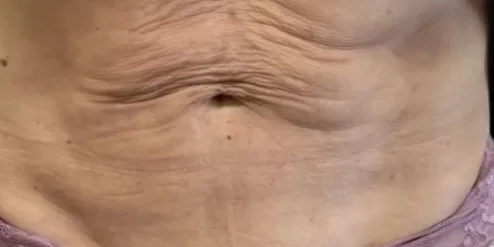
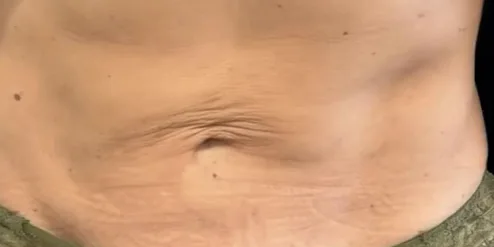
Abdominal laxity
- Indication
- Lax, crepey skin on the abdomen.
- What can happen
- Redness and swelling during the first few days. Results are individual.
Body
Microneedling with radiofrequency to restore firmness to the skin of the abdomen, with progressive improvement and no incisions.
Dr. Caíque Dias · USP-trained dermatologist · CRM-SP 218613 · RQE 137814
Quick answer
Morpheus 8 combines microneedling and radiofrequency to heat the deeper layers of the skin and stimulate collagen, treating abdominal skin laxity that can appear with aging, after pregnancy or after weight loss. Around 3 sessions are usually recommended, one every two months, and the improvement builds over months. It treats the skin: it does not remove fat and does not correct diastasis or large amounts of excess skin.
Abdominal skin laxity happens because of a gradual loss of collagen, elastin and tissue support. It can appear with aging, after pregnancy, weight loss, weight fluctuations or hormonal changes, and it shows up as loss of firmness and poorer skin quality. At the evaluation, I examine the skin, the degree of laxity and also what lies beneath it.
Morpheus is my favorite technology for treating facial and body skin laxity. It is a versatile device that combines microneedles with radiofrequency: the needles carry heat into the deeper layers of the skin, which responds by producing new collagen. That is what I call attaching the skin back to the body. When the indication and the settings are well chosen, complications are uncommon.
For the abdomen, the ideal is usually a combined protocol that redensifies the skin and stimulates collagen at different depths. I often combine Morpheus with calcium microsphere bioactivation, which can help with firmness, skin quality and tissue retraction progressively. And I am clear at the consultation: Morpheus treats the skin. If what bothers you is stubborn fat, diastasis or a large amount of excess skin, that is a different conversation, and it may involve a plastic surgeon.
Cases published for educational purposes, in accordance with Brazilian Federal Council of Medicine (CFM) Resolution 2,336/2023. Results vary and depend on individual assessment.
After the session, redness, swelling, tenderness and small marks from the needle points are expected and usually improve within a few days. Temporary dark spots can occur, more commonly in medium and dark skin tones, and, more rarely, burns or scars, which is why sun protection and the follow-up visit are part of the treatment. Improvement is gradual, depends on the number of sessions and varies from person to person. Morpheus is not a treatment for stubborn fat or for diastasis, and in more advanced laxity, with significant excess skin, surgery may be the more appropriate indication. The evaluation always comes first.
It depends on the degree of laxity and how your skin responds. In studies, the number of sessions ranges from 1 to 6, and 3 is the most common. In my protocol, sessions are spaced every two months. The plan is defined at the evaluation.
It is short. In the first days, the skin is red and swollen, with small marks from the needles, which usually improve within a week. Most people return to their routine within a few days, with sun protection and following the instructions from the follow-up visit.
No. Morpheus treats skin laxity, focusing on firmness and quality. It does not replace liposuction and does not correct diastasis, which is the separation of the abdominal muscles and is usually treated surgically. When there is a large amount of excess skin, an evaluation with a plastic surgeon may be the way to go.
The cost depends on the evaluation: the size of the area, the number of sessions and any combination with calcium microsphere bioactivation. It is provided at the consultation.
Other treatments
Tell me what bothers you, and together we'll decide what's worth treating.
Book on WhatsApp